

Someone asks who you build software for, and you start listing industries. A claims platform, an HR system, a compliance portal, a grant reporting tool. The list does not sound like a niche, so you look for the one sector that covers most of it. A software company niche can be an industry, but it can also be the shape of the work, and that is the version most guides never mention.
Two usual answers, and a third
Most guides frame the choice as industry against discipline. Pick an industry and you become the firm that knows dentists, or freight, or credit unions. Pick a discipline and you become the firm that does mobile apps, or data pipelines, or integrations. Both are real answers, and both are about what you sell or who you sell to.
The third answer is about the work itself. Some processes look the same in every sector, and a firm can get very good at one of them. We describe our own position this way: horizontal on industry, vertical on problem. We work in any industry, and we solve one kind of problem, operations that run on documents.
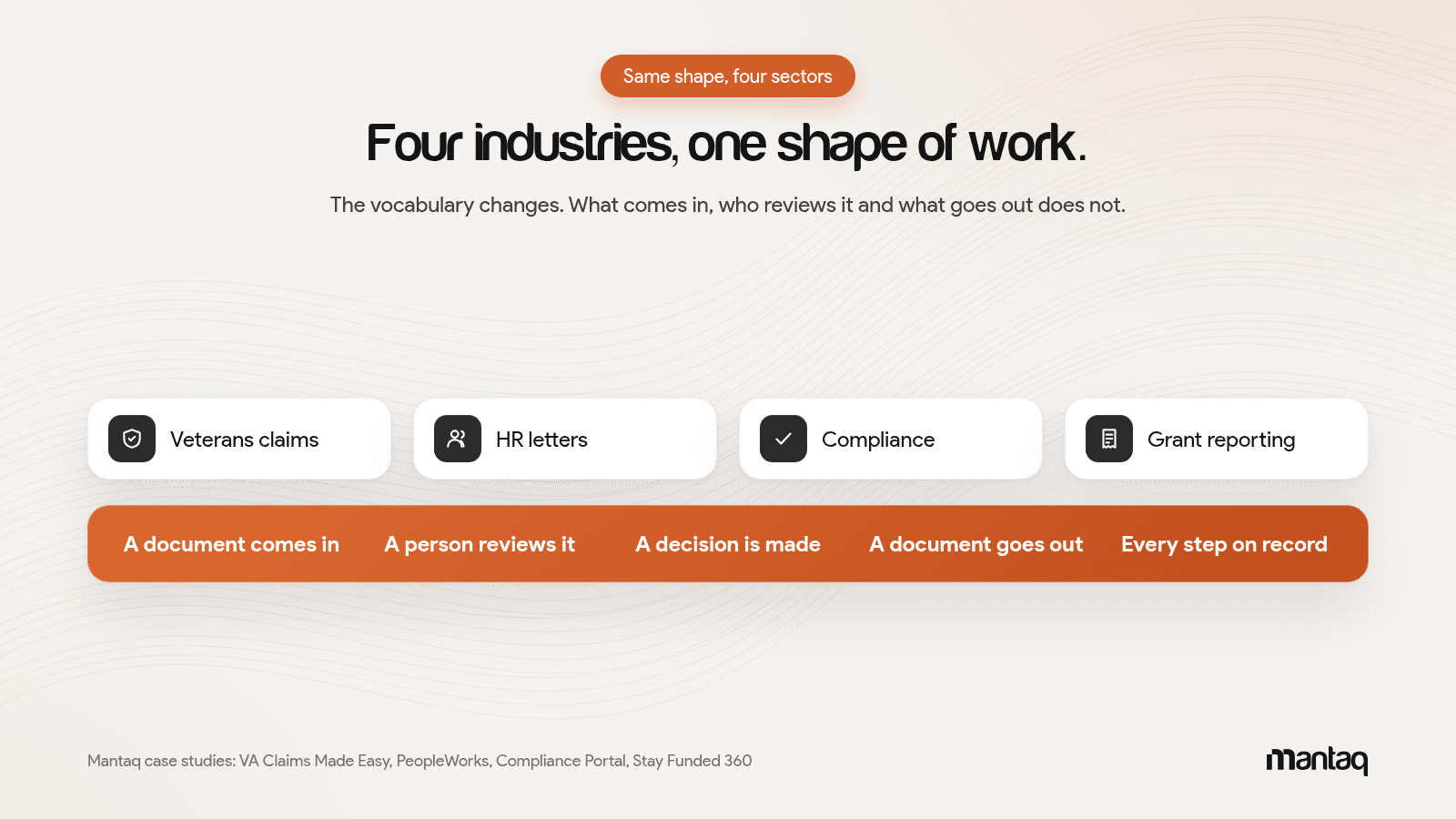
What a shape of work looks like in four industries
The shape is short. A document comes in. A person reviews it. A decision is made. A finished document goes out. Later, someone has to prove all of it happened correctly.
In VA Claims Made Easy, a veteran uploads medical records from a phone, AWS Textract pulls out the conditions, and a VA agent or doctor reviews and edits every drafted document before the veteran sees it. At PeopleWorks, an HR letter is built from the right letterhead and the employee's data, then goes through HR review, company approval and the employee's signature.
The compliance portal reads an uploaded licence, suggests its values and blocks approval until a person confirms them. In Stay Funded 360, a receipt is photographed when the money is spent, read, confirmed by a person and assembled into the monthly packet.
Claims, HR, compliance and grant reporting share almost no vocabulary. Their rules differ and so do their buyers. The work underneath is the same, and so are the places it breaks: the retyping, the missing page, the approval nobody chased.
What AI changes about the moat
Industry knowledge used to be the slow thing to acquire. You spent years learning how a sector talks and where its forms live. Today a capable team can pick up a sector's vocabulary far faster than that, so the sector alone is a thinner reason to be chosen.
Two investor reports point the same way. A Hustle Fund market map of vertical AI, dated October 2026, treats the buyer's recurring job as the useful unit and places each company by its first workflow. The CB Insights AI 100, from May 2026, says the vertical AI companies pulling ahead are defined by what their data looks like, not by the sector they serve.
Both are views of AI product companies from investors, not advice for a firm choosing its clients, so treat them as a direction and not a rule. Our reading is plain enough. If the sector can be learned and the shape of the work cannot be faked, the shape is the better thing to build a reputation on.
When an industry niche is still the better call
A problem niche has a real cost. It is harder to say in one line. "We build document workflow systems" is clearer than nothing and less vivid than "we serve credit unions", and a buyer who wants a firm that already knows their world may not wait for the explanation.
The second cost is that rules differ by sector, sometimes enough to change the design. Substance use records, for example, carry a second rule on top of HIPAA, and that changes how a system has to be built. A firm that serves many sectors has to check which rules apply before it quotes, every time.
An industry niche wins when buyers gather in one place and talk to each other, because one good project then travels fast. If that describes your market, say the industry out loud.
How to test your own project list
Lay your last few projects side by side and ignore the sector column. Then ask three things of each one:
What came in, and in what form?
Who looked at it, and what did they decide?
What went out, and what proof of it do you still keep?
If the answers keep matching while the industries do not, you may already have a niche you have not named. If they do not match, an industry may be the better way to be specific, and that is a fine result too.
Back at the question from the start, the answer can be shorter than a list of sectors. A document comes in, a person reviews it, a document goes out, and every step is on record. If that is the work you want to be known for, our services page shows how an audit, a build and ongoing support fit together, and we can talk through your own project list in a 30-min call.
Frequently asked questions
How do you choose a niche for a software company?
Lay your past projects side by side and look for what repeats, whether that is a sector, a technology or a kind of work. Choose the repeat that clients keep paying for and that you can explain in one sentence.
Is it better to specialise in an industry or a problem?
Neither wins every time. An industry fits when buyers gather in one place and want someone who knows their world, and a problem fits when the same work shows up across sectors.
Can you niche without limiting your market?
Yes, if the niche is the shape of the work and not a sector. The market is then every business that has that kind of work, though you accept a harder one line pitch.
How many projects do you need before you pick a niche?
Enough that a pattern shows up more than once across different clients. A fixed number matters less than seeing the same work return in places that otherwise look unrelated.
Does AI make niching less important?
It makes a sector niche easier to copy, since vocabulary is quicker to learn than it was. A niche built on knowing where a particular kind of work breaks is harder to copy.