
It is a quiet afternoon and a planned machine swap goes ahead. Ten minutes later writes fail everywhere while reads look fine. A last known good configuration is the most recent set of settings that actually worked, kept so a system can fall back to it when new settings turn out to be bad. GitHub's report on its outages of October 7, 2026 shows what a missing check costs, and why routine maintenance deserves the care of a deploy.
The ten minutes when only writes failed
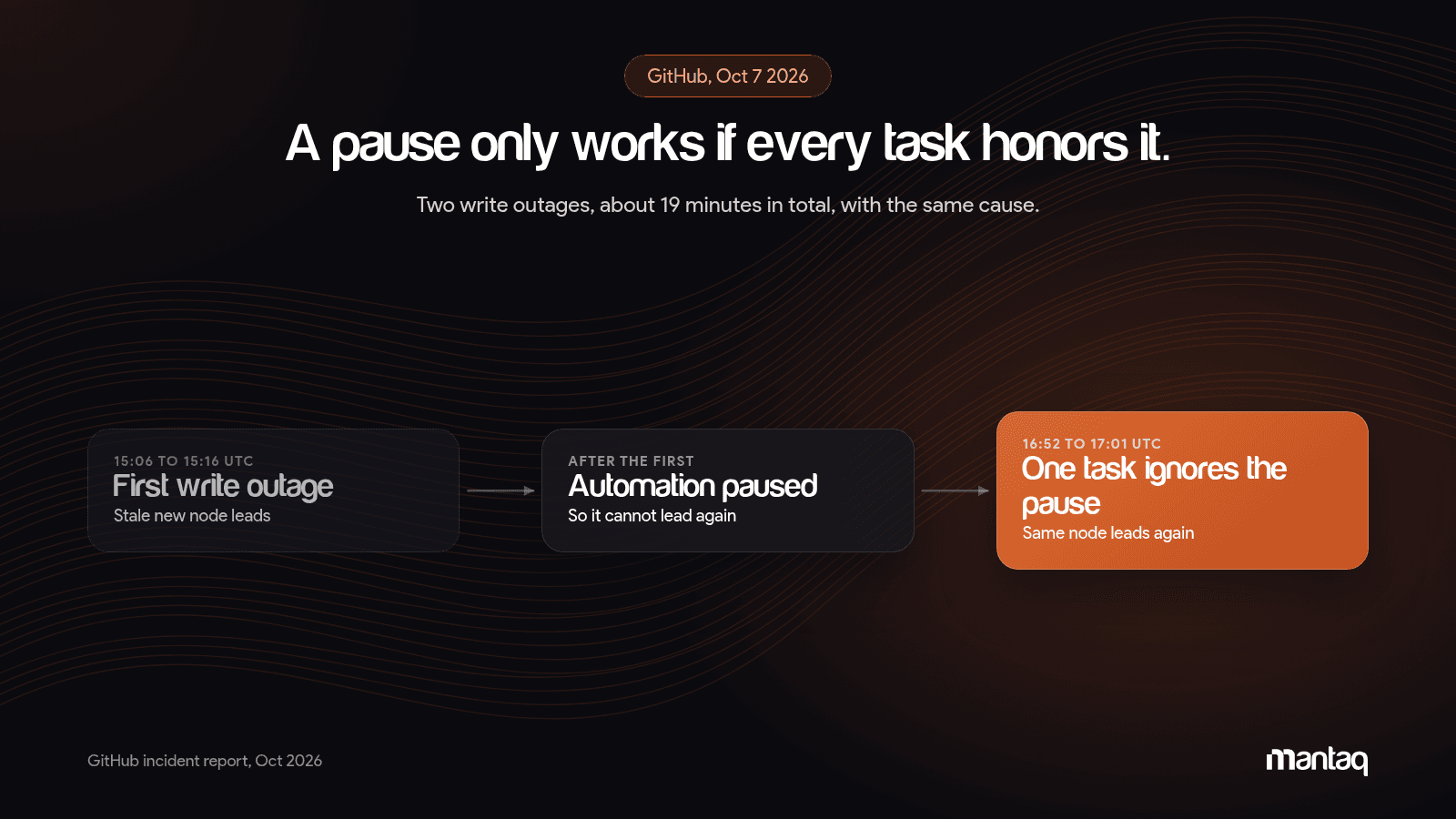
According to GitHub's incident report, there were two outages of write operations on October 7, 2026, about 19 minutes in total. The first ran from 15:06 to 15:16 UTC and the second from 16:52 to 17:01 UTC. Anything that saves or changes data failed, across Git operations, pull requests, issues, Actions, the API, sign in and more. Reading data was largely unaffected.
In the first outage, 5.6% of all web and API requests failed, peaking at 8.9%, and more than 12,000 organizations saw failures. GitHub also reports that no databases lost data and that operations retried after recovery succeeded.
What the new machine brought with it
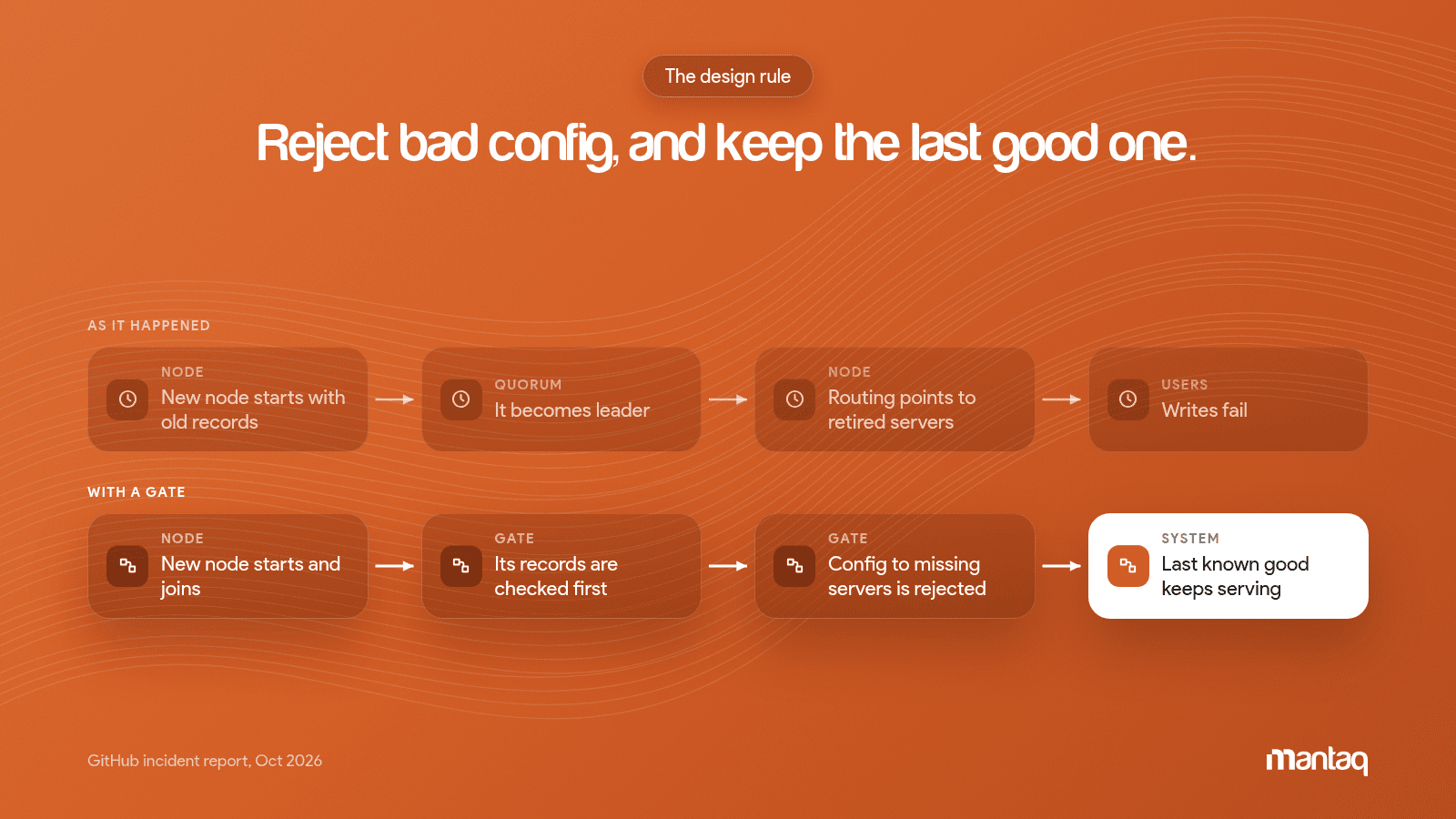
The trigger was routine. GitHub relies on an internal service that tracks which database servers should receive new and updated data. During regular maintenance, it replaced machines that run this service. One of the new machines started with an outdated copy of its records, and those records still listed database servers that had already been retired.
When that node came online, it changed the routing configuration using the outdated records. Write requests were sent to database servers that no longer existed. A machine arrived with an old picture of the world and was allowed to act on it.
The report is a short summary, so what the stale records look like inside is not public. What it does show is the shape of the failure, and that shape is common.
Why the pause did not hold
Each outage ended the same way: one of the established machines, with correct configuration, became the leader of the quorum and sent the correct configuration out. After the first outage, the team found the new machine and paused automated maintenance so it would not become leader again.
At 16:52 UTC, an automated maintenance task that did not honor the pause put it back in charge, and the outage happened again. GitHub says the automation not honoring the pause was a new regression, caused by an update of its puppet infrastructure. A pause is a promise made by a person and kept by every automated task, and it only takes one task that does not know about it.
Reject bad config, keep the last good one
GitHub's list of fixes has two halves. One is about the new machine, covered in the next section. The other is about the configuration itself: GitHub says it is changing its systems to reject configuration that points to servers that do not exist, and to keep using the last known good settings instead.
That is the rule worth copying, and it is a plan on GitHub's side, not something the report says is already in place. A consumer of configuration should check that what it was handed makes sense before it applies it. A route to a server that does not exist is a check a script can run in milliseconds. If the check fails, the consumer keeps what it has and says so, loudly. The system carries on in the old, working state while a person looks into the new one.
Gate new nodes before they can lead
The other half of the fix is about trust. GitHub says it is clearing retired database servers from the service's records before any new machine is added, and keeping new machines from being elected leader until their records have been checked.
Put plainly, a node earns the right to lead. It joins first, proves its state is current, and only then takes part in decisions that change routing. This is a different safeguard from the one before it: one stops stale state from gaining authority, the other stops invalid configuration from being applied. For anyone replacing a machine next week, that means a checklist step before the swap: what does the new node believe, who told it, and can it lead before anyone has checked?
We build the same kind of refusal into our document systems. In Stay Funded 360, the packet download is blocked while a receipt is missing, and the missing record is named. The system does not warn and carry on. It stops, because an incomplete packet that goes out is worse than a delay.
Where last known good goes wrong
Falling back is not free. A last known good setting can hold an old value for a long time, quietly, while the world changes around it. A system that has been running on yesterday's settings for a week looks healthy right up to the day it matters.
So the fallback needs an alert whenever it is in use, and someone has to own that alert. It also does not replace checking a node's state before it joins. The two work together: the gate keeps stale state from getting in, and the fallback limits the damage if something gets past it.
Back at the swap on a quiet afternoon, the questions to ask are short. What will this node believe when it starts, and what is it allowed to change? If you cannot answer both, the swap is a deploy. If your own checks live in a person's head instead of a system, our services page shows how we map them, and we can talk through it in a 30-min call.
Frequently asked questions
What is a last known good configuration?
It is the most recent configuration that worked, saved so a system can return to it if new settings fail. The phrase is best known from the Windows boot menu, and the same idea applies to servers and services.
How do you make a new node safe to add to a cluster?
Do not let it lead until its state has been checked. Clear retired entries from its records before it joins, and have it prove its data is current first.
Why did the same outage happen twice in one day?
Because a task that did not honor the pause put the faulty machine back in charge. GitHub says that was a regression from an update of its puppet infrastructure.
Should a system ever refuse to apply a config change?
Yes, when the change points at things that do not exist. Keep the last good settings, raise an alert and let a person look.
What should a post incident review of this kind of outage cover?
Cover how the bad state got in, why the first fix did not hold and what check would have stopped it. Add who owns the alert when the fallback is in use.