

In a Monday meeting you learn that a letter to a client was drafted in a personal chatbot account, and nobody read it before it went out. Nothing was wrong with the letter. That is not the comfort it sounds like. A useful AI policy for small business is short and lists decisions, not tools: for each document that leaves the building, it names the person who confirms it.
The meeting where you find out
The scene is made up, but the numbers behind it are not. A report from Goldman Sachs in October 2026, based on a survey of 2,473 alumni of its small business program, found that 74% of owners who use AI have no formal policy for how their employees use it. The same report found that 86% of those surveyed use AI, and 15% have fully integrated it into core operations.
Treat that as a signal from one group, not a count of all small businesses. Respondents are alumni of a single program, the answers are self-reported, and Goldman published the report alongside a new AI training institute. Still, it is a useful sign that use has run ahead of the rules.
What the templates cover, and what they skip
Search for an AI policy and you will find templates. They list approved tools, tiers of data that must never be pasted into a chatbot, and uses that are banned. All of that is reasonable and worth having on a page.
What they tend to skip is the question that causes the damage: which decisions may an AI draft, but only a named person may confirm? A banned tool list does nothing for a letter drafted in an approved tool and sent without a read. The harm is rarely which tool wrote the words. It is that nobody owned the sentence.
List decisions, not tools
Tools change every quarter. The documents your business sends out do not. So build the policy around those: the client letter, the invoice, the claim, the credential, the report to a funder.
For each one, write three things. What the AI may do with it, such as read it or draft it. Who confirms the result, by name or by role. And what happens if that person has not confirmed, which should be that the document does not go out.
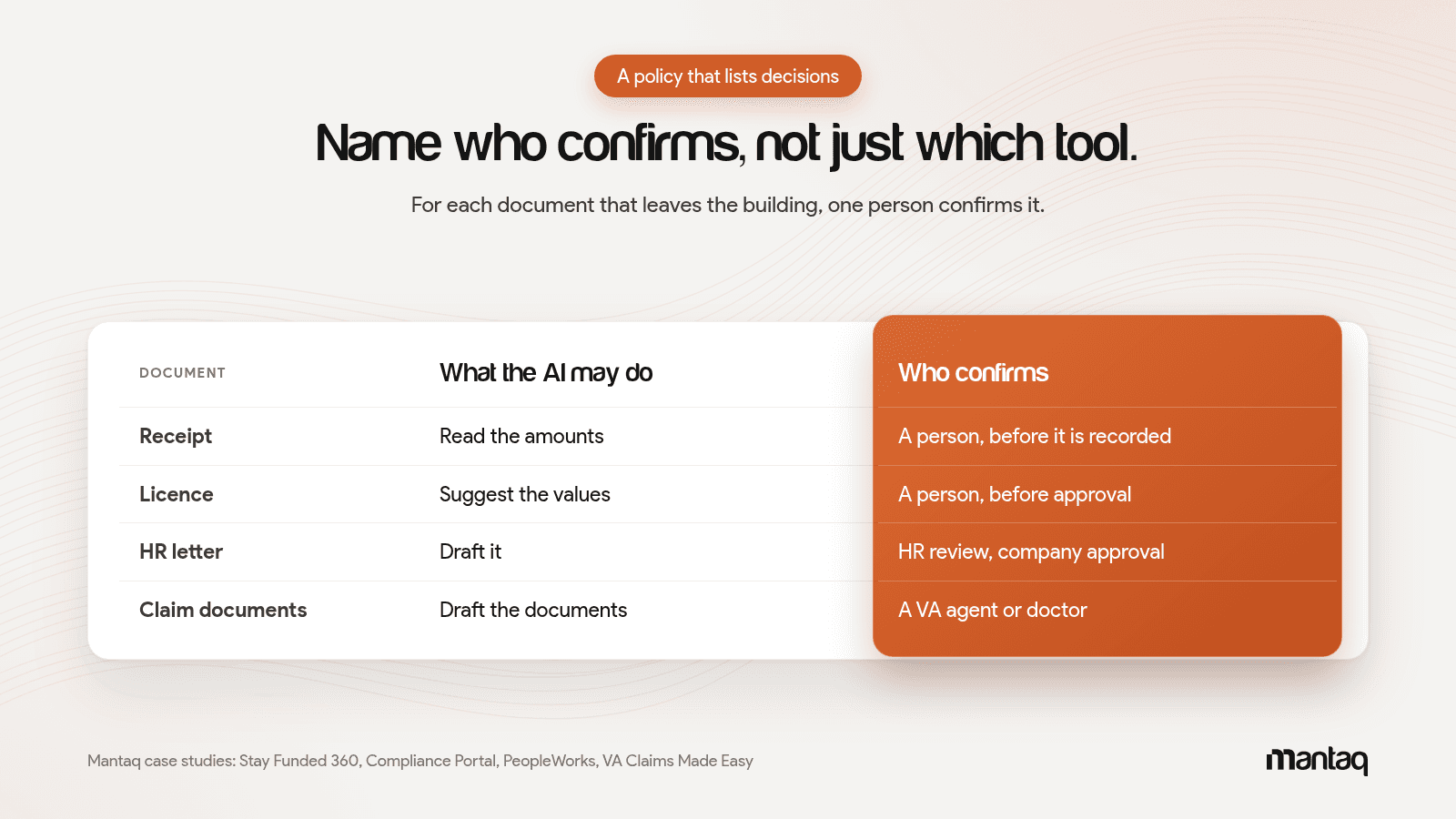
This is the rule we build systems on. AI reads and drafts, the workflow records, and a person approves. The same sentence works as a policy.
Block it in the workflow, do not just warn
A policy that lives in a document relies on memory, and memory fails on the busiest day. The stronger version is a system that will not let unconfirmed work move on.
In the compliance portal we built for a behavioral health operator, uploaded documents are read and their values suggested, but nothing is committed until a person confirms, and approval stays blocked until then. In Stay Funded 360, the download is blocked while a record is missing, and the missing record is named. Blocked, not warned.
That is not available to every small business on day one, and it is not needed for every document. But it shows the difference between a rule people are asked to remember and a rule the work cannot get around.
What an AI policy for small business needs on one page
You do not need a long document. One page is enough to start, and it is more likely to be read.
List the five documents that leave your business most often.
Next to each, write what AI may do with it.
Name the person or role who confirms it before it goes out.
Add the data that must never go into a personal chatbot account.
Say who people ask when they are unsure.
Then read it aloud to the team. If a step cannot be done by an actual person on an ordinary Tuesday, change the step. A policy nobody can follow becomes a policy nobody mentions.
One limit before you start. A policy does not stop misuse by itself, and this is not legal advice. If any of your documents are covered by rules about records or privacy, check those rules for your own business.
Back at the Monday meeting, the better outcome is not a ban on chatbots. It is a letter that had a name next to it before it left. If it would help to go through your own documents, our services page shows how we map them, and we can do it in a 30-min call.
Frequently asked questions
Do small businesses need an AI policy?
If anyone on your team uses AI for work that leaves the business, yes. It can be one page, but it should say who confirms what.
What should an AI policy for a small business include?
The documents that go out, what AI may do with each, who confirms the result, and the data that must never be pasted into a chatbot. Add a name to ask when someone is unsure.
Who should be responsible for AI output in a business?
A named person, not the tool. For each type of document, one role confirms it before it is sent or recorded.
How long should an AI policy be?
Short enough that people read it, usually one page to start. A long policy that nobody opens protects no one.
Can a policy replace review of AI work?
No. A policy says who reviews and when, but the review still has to happen. A system that blocks unconfirmed work makes it harder to skip.