

Almost every large company now uses AI somewhere. Far fewer have changed how their work actually runs, and that gap decides who gets value from it. This post brings together the latest public research on adoption, jobs and productivity, and ends with the steps that move a team from trying AI to running on it.
Nearly every company uses AI, few see results
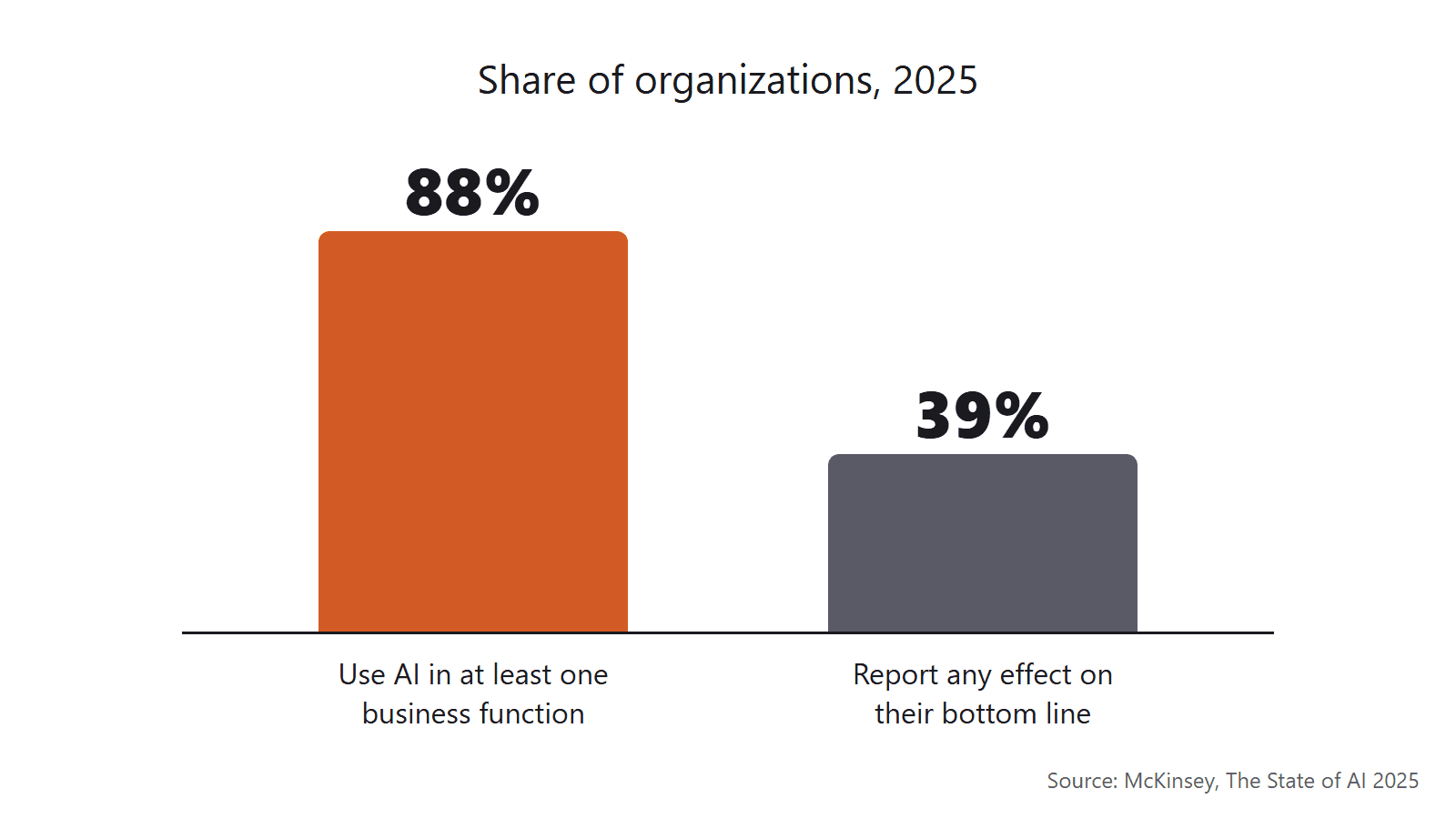
AI in business went from experiment to default in about three years. McKinsey's State of AI 2025 survey found that 88 percent of organizations use AI in at least one business function, up from 78 percent a year earlier. Stanford's 2026 AI Index reports the same 88 percent.
Results lag far behind. In the same McKinsey survey, only 39 percent of companies could point to any effect on their bottom line. Most are still running pilots: a chatbot in one team, a writing assistant in another, nothing connected to the core of the business.
People outside work moved just as fast. Stanford reports that generative AI reached 53 percent of the population within three years of launch.
The technology is no longer the bottleneck
The models improved sharply in a single year. Stanford's index tracks two tests that map closely to real work:
Coding: on SWE-bench Verified, where models fix real software bugs, scores rose from 60 percent to near 100 percent.
Computer tasks: on OSWorld, where an AI agent completes tasks inside real desktop apps, success went from 12 percent to about 66 percent.
Money followed the progress. US private investment in AI reached $285.9 billion in 2025, more than 23 times China's $12.4 billion, according to the same report. A company stuck in pilots today is rarely limited by what the tools can do.
Jobs are shifting more than they are disappearing
The World Economic Forum's Future of Jobs Report 2025 expects 170 million new roles and 92 million displaced roles by 2030, a net gain of 78 million. That churn touches 22 percent of today's jobs.
The IMF estimated that almost 40 percent of jobs worldwide are exposed to AI. In advanced economies the figure is about 60 percent, against 26 percent in low-income countries. Exposed does not mean replaced. The IMF expects roughly half of the exposed jobs in advanced economies to gain from AI help, while the other half face lower demand.
The pressure lands hardest at the entry level. Stanford researchers found in Canaries in the Coal Mine that workers aged 22 to 25 in the most AI-exposed jobs, such as software development and customer service, saw a 13 percent relative drop in employment. Older workers in the same jobs held steady or grew.

Skills move with the jobs. The WEF expects nearly 40 percent of the skills used at work today to change by 2030, and 63 percent of employers already name the skills gap as their biggest barrier to change.
AI helps the least experienced people most
When AI sits inside the daily workflow, the gains are measurable. Erik Brynjolfsson, Danielle Li and Lindsey Raymond studied 5,179 customer support agents in Generative AI at Work. An AI assistant raised the number of issues each agent resolved per hour by 14 percent on average.
New and less skilled agents improved by 34 percent. Experienced agents barely changed. The assistant had learned from the best agents' conversations, so it passed their habits on to everyone else. The study also found happier customers and fewer agents quitting.
This changes how to read the entry-level numbers above. AI is taking over some starting tasks, and it also brings new people up to speed much faster. Companies that use it to train junior staff, not only to replace them, keep their talent pipeline working.
Teams that get results change the work, not just the tools
The gap between using AI and getting value from it comes down to a few choices:
Redesign the workflow. Adding a chatbot to an old process gives small gains. Rebuilding the process so AI handles the repetitive steps gives large ones.
Start with one costly, repetitive process. Pick work that eats hours every week, such as reading forms, matching receipts or answering the same questions. Measure how long it takes before you change anything.
Keep people on the decisions. Let AI draft, sort and suggest. Let a person approve anything that affects money, customers or compliance. Stanford counted 362 documented AI incidents in 2025, up from 233 the year before.
Train the team as you roll it out. Employers rank the skills gap as their top barrier, and it does not close by itself.
Measure in hours and errors. A result is a number, such as hours saved per week or mistakes caught per month.
Pick one process and rebuild it
Most companies already pay for AI tools. The next step is choosing one process and redesigning it so the tool does the repetitive part and people own the judgment calls.
Mantaq builds AI automation, internal tools and integrations for teams at exactly this point. If a process in your company eats hours every week, talk to us and we will map where AI fits.